Rosetta Stone Learning Center

  • Home
  • About
  • Teach
  • Work
  • Grow
  • Apply
  • FAQ
  • Blog

Wishing you good cheer in the New Year!

FacebookTwitterLinkedInEmail

How do you welcome the New Year?  

The beginning of a new year is a time to reflect on the year gone by, and make plans for the future. Some people go to shrines and temples, hoping to change our lives for the better.  We tip a glass of sake or wine with our family.

During this special time of the year, we give and receive warm greetings to our loved ones. These inspiring messages will be especially important as we express our hopes and dreams for better days ahead in 2022 after surviving the challenging year of 2021!



There are many お正月 (Oshogatsu) New Year’s phrases in Japan, but what phrases are there to use as greetings?

Today, I would like to introduce two phrases, one commonly used at the end of the year and the other at the beginning of the year, and why they are used at those times.


よいお年を!

( Yoi otoshi wo! )

よいお年をお迎えください! 

( Yoi otoshi wo omukae kudasai!) 


The phrase「よいお年を」 “Good New Year” is an abbreviation of the phrase 「よいお年をお迎えください」 “Please have a good New Year.” However, when greeting your superiors at the end of the year in business situations, it is common to politely say 「よいお年をお迎えください」instead of abbreviating it to「よいお年を」.

If you have been using this phrase in the sense of “Have a good New Year,” did you know that there is a difference in perception from the original meaning? As the end of the year is a hectic time with many events, the phrase is used in the sense of “I hope you will finish your various events and complete your preparations for a good new year.  It also expresses the feeling of “Let’s work hard at the busy year-end season and welcome a happy new year.”

For the above reasons, the greeting「よいお年を」is usually not used on 大晦日 (Omisoka) – December 31.

It is not necessary to say 「よいお年を」on December 31 because the New Year’s preparations should have already been made. The appropriate time to say this phrase is from mid-December to December 30. However, sometimes people say it on New Year’s Eve accidently and it might make the other person uncomfortable.  But they have no offense intended.

When greeting people on New Year’s Eve you can always use the safe phrase:


「来年もよろしくお願いします」

(Rainen mo yoroshiku onegai-shimasu.)

“I look forward to seeing you again next year”. 


明けましておめでとうございます

( Akemashite omedetou gozaimasu! )


「明けましておめでとうございます」”Happy New Year!” is a phrase that is often used as a New Year’s greeting. It is a phrase that expresses congratulations on successfully passing the year and welcoming the new year. It has become a standard phrase you can see on New Year’s greetings and New Year’s cards.

「明けまして」refers to the end of one period or one state and the beginning of the next. In other words, 「明けましておめでとうございます」means that the last year has ended and the new year has just begun anew.  And it also expresses our feelings of quiet and holy celebration of the New Year.

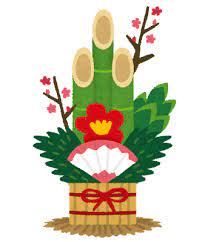
The time to say this phrase is during  松の内 (Matsunouchi), when the gods of the year come and stay in each of our houses.  In Japan, this period during the New Year’s holiday is when New Year’s decorations such as 門松 (kadomatsu), the special decoration using pine trees (matsu) is displayed to welcome the gods. The end of Matsunouchi is when the gods of the year leave the house, so we put away the New Year’s decorations.

The New Year’s holiday differs from region to region, and in the Kanto region it is until January 7, while in the Kansai region it is until January 15.


Some casual ways to say Happy New Year to your friends in Japan

In more casual settings, that is to say between friends or among young people:


「あけおめ!ことよろ !」 (Ake ome! Koto yoro!) can be heard quite frequently.

It simply is a shorter version of “あけましておめでとうございます。今年もよろしくお願いします”

(Akemashite omedetō gozaimasu. Kotoshimo yoroshiku onegai shimasu).

“Happy New Year! I look forward to seeing you again this year.”


In Conclusion

When greeting the Japanese people around you for the New Year’s holidays, why not express your gratitude for last year and greetings for this year in Japanese with all your heart?



どうぞ、よいお年をお迎えください☆

May your days be merry and bright★

 

Pointers for Better Online Teaching

FacebookTwitterLinkedInEmail

With economies across the world stalled under the effects of the Coronavirus, lives and work have been upended for most. For those fortunate enough not to have suffered the direct health effects of the virus or the grief of lost loved ones, there is still the uncertainty of employment to handle. For many teachers here in Japan, this means either job loss or drastic pivoting in our modes of work. 

While teaching online is nothing new in the field of education, and English language learners are accustomed to taking lessons from the comfort of their own homes, the need to stand out in the market has increased after the influx of online teaching during the pandemic. Simple standards kept across all teaching platforms can improve marketability and sustain performance. The following is not an exhaustive list but should be a foundation for steady delivery while working remotely.


Lighting & Background


Good lighting is standard, but this becomes paramount when your Zoom meetings become an essential part of how you deliver your service. Lighting should be overhead and facing you without spotlighting you against the background. Plain backgrounds are best. Too-casual environments and cluttered or broken backgrounds may not be obviously detrimental, but you miss out on the chance to re-create the focused zone that a classroom atmosphere would otherwise invoke.

Controlling your environment is also a way to set yourself apart in the market. If students see the same, near-perfect lighting each time they have a lesson with you, they will begin to associate it with you. This is an obvious advantage over competitors whose teaching environments are distracting or inconsistent in quality. Of course, if you are working with a company, adhering to its protocol and using a company-themed virtual background is usually preferred. However, with many teachers working freelance after major cut-backs or bankruptcies, setting a personal protocol is a good way for them to elicit this brand effect.


Positioning


Keeping an appropriate distance from the camera and being aware of when and how you leave this position in order to demonstrate your material will also go a long way in managing the lesson flow. Having a good sense of a center to which you return regardless of what you do on screen elicits an expectation from the student that can help ground their focus on the material rather than your image. Having a sustained awareness of a center will also help cut down on distractions that you might not be aware of when you are engaged in the lesson. 

Try to keep a distance from the screen that sets you squarely in the frame from the chest up. Many Zoom users make the mistake of sitting back from the screen as they would when watching programs or sitting in meetings. The other mistake is to lean in close to the screen while looking at the material being presented. This can be distracting enough in general meetings, but during a lesson, it can lead to the focus shifting from the material to the teacher, especially if your camera refocuses with changes to the picture. Keeping the focus flowing with the pace of the lesson should be foremost where student production is a mainstay of the service.


Quality


Photo by Lesia Valentain

Some other things to consider for effect are basic elements of quality. It’s easy to forget about voice tone and volume, especially if you are not accustomed to adapting your personal audio needs to a work standard. Make sure your microphone and camera are adequate to handle the needs of your students. Be sure to maintain a steady pitch of voice as well. Many teachers fall into the habit of speaking too softly online due to hearing themselves in the headset. The other temptation is to shout-talk into the receiver. Although it’s easy to forget your voice tone in a long day of lessons, keeping an even tone of voice will help you in other aspects of your delivery, such as language grading.

Another basic element of quality maintenance is the keeping of company standards if you are working under contract. Most companies have software that connects their instructors and students. It will only be to your advantage to be squared away with its ins and outs so that when technical issues arise, you are able to stay professional and resourceful. 


Attire


For teachers who are working under contract with English language schools, having a consensus on dress code is a simple way to maintain the company image. For those working freelance or with companies that do not maintain a standard for clothing, it can still benefit you to keep a standard for yourself. This latter situation needn’t be formal or even business apparel. Simply maintaining a similar standard for every lesson helps contribute to the personal brand that you are building through sustained efforts to keep your teaching environment the same across lessons.


Workstation


Photo by Samule Sun

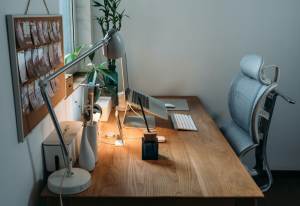
Other than the computer and yourself, the desk is probably the most important tool in the workspace. Creating a workstation that supports your positions from the start is the best way to set yourself up for sustained performance. Ergonomics gets a lot of traction these days, but thinking more in terms of general wellbeing is probably best for those of us juggling home life with work. As the pandemic continues and remote work is extended beyond what many have planned for, giving enough attention to a healthy work space early on can save you the time and lost energy of constant adjustments. 

When setting the height of your desk or chair, elbows should rest comfortably at your side at a ninety degree angle. This allows you to keep your back in the recommended “S” position –  not bolt upright but relaxed with natural curvature of the spine and shoulders held back. Finally, position your monitor so that the top of the screen is at eye level. This will encourage you to maintain a level gaze and not pitch forward or tilt your head back through the hours.

The desk should also support this posture. The temptation to lean into the computer screen is perhaps greater for teachers as we are connecting with other individuals directly throughout the day. This is especially true for those of us teaching in Japan and using kotatsu or other low surfaces for telework. A table that is too high will also encourage you to lean forward as you tire of lifting your elbows. Over the course of the day, this will mean pressure on the diaphragm and shallow breathing. 


Staying Connected


Photo by Chris Montgomery

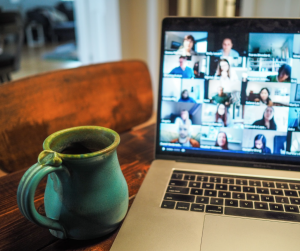
For those of us teaching with companies, don’t miss the feedback you would normally get from an office environment. While it might be great to work independently, if you are still part of a team, regularly seek out contact with a supervisor or colleague. Touching base will ensure that you don’t miss out on valuable information, coaching, and the subtle smoothing of the edges that occurs in more directly collaborative environments. 

While our offices may be spread thin, our workloads are not, and staying in touch with your colleagues becomes therefore much more important in keeping the team together. Especially in fast-paced  environments, the danger of siloing is greater when you are out of the office environment. Proactively engaging the regular tools of communication and scheduling regular video meetings with team members or managers is important to staying informed and keeping your work in line with your team. It’s also just good practice for team spirit and motivation and an element over which you can exercise significant control.


Conclusion

While much of the above advice is simple and seemingly obvious, it is easy to neglect. Keeping these standards in place will have a cumulative effect on performance in the long run. Thinking of the ideas like a process that is up to you to keep running smoothly will allow you to keep distractions to a minimum and have lesson quality remain the proper focus of your work. 

Quick Links
  • About Us
  • Teaching Positions
  • Our Schools
  • Training & Development
  • Apply
  • FAQ
  • Blog
View Available
Job Openings
Visit Gainjinpot.com
Contact Info
hr@rosettastone-lc.jp
Connect With Us
Quick Links
  • About Us
  • Teaching Positions
  • Our Schools
  • Training & Development
  • Apply
  • FAQ
School List
  • Ginza
  • Shinjuku
  • Ikebukuro
  • Kabukiza Tower
  • Umeda
Terms & Conditions . Privacy Policy
Copyright © Rosetta Stone Learning Center . All Rights Reserved
  • Home
  • About
  • Teach
  • Work
  • Grow
  • Apply
  • FAQ
  • Blog